
Every election brings a new list of promises. Every news cycle brings a new crisis. Every political party has its own explanation for what is wrong with America and what should be done about it.
But the biggest challenges facing the country do not disappear when the headlines change.
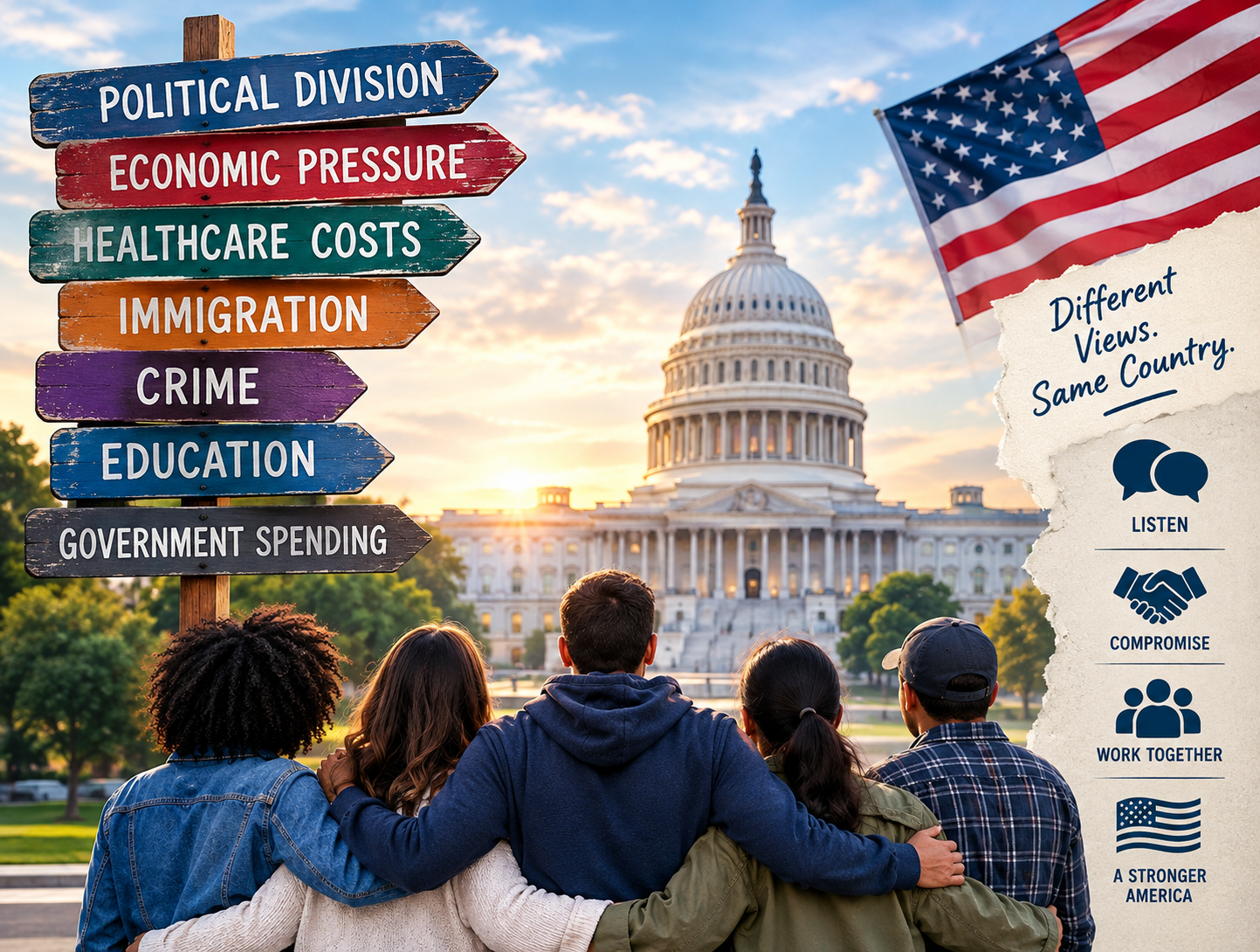
Political division, economic pressure, declining trust, debates over constitutional freedoms, healthcare costs, immigration, crime, education, and government spending continue to affect Americans in very real ways. Recent Pew Research Center surveys have found that Americans continue to rank issues such as inflation, healthcare affordability, and political cooperation among the country’s major problems.
The question is not whether America has problems. It does.
The question is whether Americans can work through them without allowing every challenge to become another reason to turn against one another.
Political Division Is Making Problems Harder to Solve
America has always had political disagreements. What has changed is how much those disagreements can dominate everyday life.
When every issue becomes a battle between “us” and “them,” compromise starts looking like weakness. Listening becomes surrender. Changing your mind becomes something to be embarrassed about.
That is a dangerous way to approach complicated problems.
Most national issues do not have simple solutions. They require debate, evidence, negotiation, and sometimes difficult compromises. Citizens can demand better from their leaders without treating every political opponent as an enemy.
A functioning democracy needs disagreement. It also needs people willing to keep talking after the disagreement.
The Growing Problem of Trust
Americans need to be able to trust institutions enough to participate in public life, while institutions need citizens who are willing to question them when necessary. Those two ideas are not contradictory.
Blind trust is not healthy democracy. Neither is assuming that every government action is automatically corrupt or every institution is automatically dishonest.
Research from Pew has found that many Americans believe low trust in government and in other citizens makes it harder to solve important national problems.
Rebuilding trust will require something simple but difficult: accountability.
That means:
- Leaders should be questioned.
- Government decisions should face public scrutiny.
- Citizens should check facts before spreading claims.
- Political parties should not receive automatic loyalty.
- People should be willing to acknowledge mistakes on their own side.
Trust is earned through actions, not slogans.
Economic Pressure Is Personal
Economic problems are not abstract numbers for the people living through them.
When prices rise, families notice. When healthcare becomes harder to afford, they notice. When housing costs consume more of a paycheck, they notice. When people worry about jobs, debt, retirement, or the cost of raising a family, politics becomes personal.
Pew’s research has repeatedly found economic concerns near the top of Americans’ list of national problems. In a 2025 survey, 63% of adults called inflation a very big national problem, while 67% said the affordability of healthcare was a very big problem.
These challenges cannot be solved simply by blaming one political party or one group of Americans.
They require serious discussion about policy, spending, wages, healthcare, housing, taxes, and economic opportunity.
Protecting Constitutional Freedoms
Another challenge is protecting the rights and freedoms that allow citizens to participate in public life in the first place.
Freedom of speech, peaceful assembly, petitioning the government, religious liberty, due process, and other constitutional protections are not supposed to belong only to people whose opinions we like.
That principle can be difficult to accept when someone is saying something offensive or deeply unpopular.
But rights matter most when they protect people we disagree with.
At the same time, constitutional freedoms should not be treated as permission to threaten or harm others. Responsible civic participation requires both knowing your rights and understanding your responsibilities.
What Can Citizens Actually Do?
It is easy to look at America’s biggest problems and feel powerless. After all, one person cannot fix inflation, reform government, rebuild trust, or solve political division overnight.
But citizens are not powerless.
You can start by becoming more involved in the parts of public life you can actually influence.
You can:
- Learn what your elected officials are doing.
- Contact representatives about issues that matter to you.
- Participate in local civic activities.
- Have honest conversations with people who disagree.
- Support peaceful and lawful activism.
- Question leaders on your own side as well as the other side.
- Encourage people around you to stay informed and involved.
Small acts of citizenship become meaningful when millions of people take them seriously.
The Future Belongs to All of Us!
America’s challenges are not going away because we argue about them. They are not going away because another election ends. And they certainly are not going away because citizens stop paying attention.
The country needs people who are willing to stay engaged even when the conversation gets uncomfortable.
We do not need to agree on everything. We do need to remember that we share a country, a future, and a responsibility to one another.
America’s future should not belong exclusively to political parties or those holding office. It belongs to the citizens who are willing to speak, listen, question, participate, and stand together.